KHSB and Sapir College: A Unique Academic and Human Partnership
Im Rahmen der seit 2023 bestehenden Hochschulpartnerschaft zwischen der KHSB und dem
Den vollständigen Text lesen Sie hier:
KHSB and Sapir College: A Unique Academic and Human Partnership
This is the fourth year in which the School of Social Work at Sapir College has been hosted by KHSB Berlin, and it is a special opportunity to express our gratitude for this partnership.
I would like to express my sincere thanks for the ongoing spirit of sharing. In particular, I am deeply grateful to President Prof. Dr. Gabriele Kuhn-Zuber, Prof. Dr. Petra Mund, Anne Konz from the Study Organization, the International Office, and last but not least, Prof. Dr. Franziska Wächter, for organizing this week with such professionalism, thoughtful logistical care, and, above all, genuine human warmth.
What makes the relationship between our two institutions so distinctive is that it is not limited to a single visit, but is built on ongoing academic cooperation, joint virtual courses, research exchange and the shared work that brought us together to this week.
This partnership reflects not only academic collaboration, but also trust, and human connection.
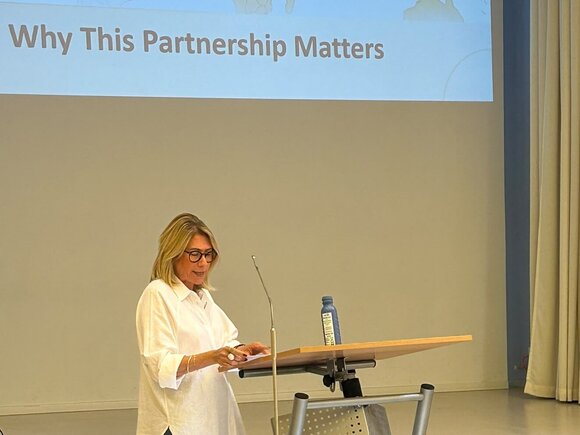
Why This Partnership Matters
The academic, personal, and warm relationship between our institutions is especially meaningful at a time when the atmosphere in parts of the international social work academy has become deeply strained in relation to Israel.
Our collaboration serves as a model and an example of how cooperation can be sustained despite past grievances.
Against this background, the openness and solidarity embodied in this partnership stand out as both professionally important and personally moving.
It is from this perspective that I would like to offer a brief reflection on what has been taking place in some schools of social work around the world since October 7.
The contrast between this partnership and the climate reported elsewhere helps illuminate why this discussion matters for social work education today.
A Hostile Anti-Israel Climate in Schools of Social Work Since October 7
Many Jewish students and faculty describe a hostile anti-Israel climate in schools of social work, which they experience as deeply threatening to them as Jews.
The central debate in the literature is whether, and under what conditions, anti-Israel or anti-Zionist discourse crosses the line into an anti-Jewish climate or antisemitism.
Sources: Yeshiva University (2025); USC Social Work; SSWR abstract (2025); Farber & Fram (2024); Response article (2024); CSWE (2025).
How This Climate Is Described
- Jewish students and faculty often describe a climate of hostility not primarily through explicit anti-Jewish slurs, but through anti-Israel discourse that renders them suspect, isolated, or morally compromised.
- In many accounts, the issue is not a single event but an accumulation of classroom dynamics, social exclusion, and fear of speaking openly.
- Several sources note that anti-Israel hostility may be experienced as anti-Jewish when Jews are treated as representatives of Israel or when Jewish identity itself becomes politically stigmatized.
Sources: Brandeis CMJS reports; Columbia Task Force Report #2 (2024); YU (2025); SSWR abstract (2025); CSWE (2025); USC Social Work.
What research studies show
- Farber and Fram (2024) argue that parts of the social work profession responded to October 7 with moral ambiguity, delayed recognition, and insufficient concern for Jewish trauma.
- Their argument suggests that anti-Israel discourse can become professionally normative in ways that marginalize Jewish students and faculty.
- The response article does not fully accept this interpretation, but it confirms that the profession is now openly debating how to distinguish legitimate political critique from an exclusionary climate
- Emerging scholarship on Jewish social work educators similarly points to fear, isolation, emotional exhaustion, and inadequate institutional support.
Sources: Farber & Fram (2024); Response to “The Danger of Ideology” (2024); SSWR paper abstract (2025).
Institutional and Journalistic Documentation
- Columbia’s Task Force documented reports of harassment, exclusion, intimidation, and administrative inadequacy in addressing Jewish and Israeli students’ concerns.
- Yeshiva University’s coverage of social work academics highlights reports of departmental hostility, ideological exclusion, publishing barriers, and fear of professional retaliation for pro-Israel expression.
- USC Social Work’s resource page signals that anti-Jewish bias and antisemitism in social work education are no longer marginal concerns, but subjects requiring structured academic attention.
Sources: Columbia Task Force Report #2 (2024); YU News (2025); USC Social Work resource hub.
The Conceptual Debate
- Not all criticism of Israel is antisemitic, and several scholarly approaches insist on maintaining that distinction.
- At the same time, institutional and research-based sources suggest that anti-Israel discourse can become anti-Jewish in effect when it targets Jews collectively, excludes them from legitimate belonging, or minimizes their vulnerability.
- The key analytical question, therefore, is not whether all anti-Zionism is antisemitism, but when a hostile anti-Israel climate becomes an exclusionary anti-Jewish climate.
Source line:
Sources: Response article (2024); Brandeis CMJS; CSWE (2025); Farber & Fram (2024).
Why This Climate Is Professionally Dangerous
- Social work defines itself as a profession committed to human rights, social justice, dignity, and the challenge of oppression; when it fails to recognize hostility experienced by Jewish students and faculty, it risks undermining its own ethical foundations.
- A hostile anti-Israel climate becomes especially dangerous in social work education because the profession does not merely respond to suffering; it also helps classify who is recognized as vulnerable, who is treated as privileged, and who is cast as an oppressor.
- When ideological frameworks predetermine who may count as a legitimate victim and who may not, social work risks replacing ethical complexity with moral sorting, thereby weakening professional judgment, pluralism, and the credibility of anti-oppressive practice.
- For that reason, the issue is not only whether Jewish pain is acknowledged, but whether social work can remain faithful to a universal human-rights ethic rather than a selective politics of recognition.
Sources: A Tool for Addressing Antisemitism: The NASW Code of Ethics; CSWE, Understanding Antisemitism; Farber & Fram (2024); Universality Lost: Antisemitism and the Teleological Crisis of Social Work; Cambridge chapter on antisemitism and anti-racist social work; Encyclopedia of Social Work entry on oppression.
Conclusion
- Since October 7, schools of social work have become an important site for examining the relationship between anti-Israel discourse, Jewish vulnerability, and professional ethics.
- The literature does not speak in one voice, but it consistently shows that many Jewish students and faculty experience the current climate as exclusionary, threatening, and insufficiently acknowledged.
- For social work education, the challenge is not only political balance, but whether Jewish students and faculty can participate fully without fear, stigmatization, or silence.
Sources: Farber & Fram (2024); Response article (2024); SSWR abstract (2025); Columbia Task Force Report #2 (2024); CSWE (2025); YU (2025); USC Social Work.
Thank you for your time and attention!
Dr. Rebecca Ranz
Bei Interesse nennt Ihnen die Pressestelle der Hochschule die ausführlichen Quellen.
Die Kooperation verbindet eine der größten Hochschulen Israels mit der KHSB und ermöglicht seit Beginn regelmäßige Begegnungen, digitale Austauschformate sowie gegenseitige Besuche von Studierenden und Lehrenden in Berlin und Israel.