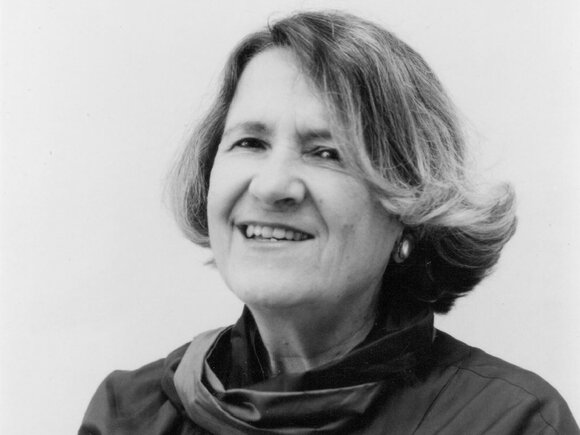
Orbituary Silvia Staub-Bernasconi
With great gratitude and deep respect, Prof. Dr. Nivedita Prasad, along with fellow companions, colleagues, and numerous graduates, remember Prof. Dr. Silvia Staub-Bernasconi in August 2026. The founder of the Master's program in Human Rights-Oriented Social Work (MRMA) at KHSB is considered one of the most important pioneers of human rights-oriented social work. Her thinking, her work, and her tireless passion for social justice have influenced many students, including those at our university.
One of Prof. Dr. Staub-Bernasconi’s most enduring legacies is the German Master's programme, 'Social Work as a Human Rights Profession' (MRMA), which has been offered every two years since 2002 as a joint programme between the Alice Salomon University of Applied Sciences, the Protestant University of Applied Sciences, and the Catholic University of Applied Sciences for Social Work in Berlin. Not only did she develop and launch this programme, she also led it on a voluntary basis until 2010. She also taught on the programme and mentored students on research projects and master's theses until 2017.
It is above all the graduates, but also the students, the (former) coordinators, the (former) faculty members, and the program administration who define the program. We share the experience that Staub-Bernasconi’s work—and for many, her very person—has influenced their professional practice and shaped and strengthened their fundamental political and professional understanding. Everyone associated with the program was invited to contribute to this obituary so that we may collectively honour her memory. I have indicated my own memories, thoughts, and additions in italics.
Regula Corsten, who set up the programme in 2002 as its coordinator, remembers Silvia as an independent and headstrong woman who would not be deterred by obstacles or power structures. She championed the Master's in Human Rights amid the challenging relationship between ZPSA e.V., the programme's sponsoring association at the time, and the three universities. With a clear goal in mind, she remained steadfast throughout the disputes. She was always focused on the programme itself, rather than her own position or person. I too fondly recall the university administrations saying that it was solely thanks to Silvia’s tenacity that the programme came into being. She loved to recount how no one believed it would last long, which was likely one reason why they decided to collaborate in the first place, to share a potential risk. She was delighted when I told her how many applications the programme was receiving.
The Theorist
For Prof. Dr. Meike Günther, Silvia’s work remains one of the most important foundations for the professional and sound addressing of human rights in social work. The question of social work as a human rights profession is closely linked to the question of social work’s mandate. In 2007, Staub-Bernasconi first wrote about a 'triple mandate'. To this day, the question of the mandate, or of demands that conflict with it, remains one of the most engaging topics of discussion among students and practitioners in the field. This is also evident from the extensive feedback received from graduates.
For Jenny-Kerstin Bauer, engaging with the triple mandate helped her to envisage a long term career in the profession. She describes it as a source of stability in professional and political discourse, and as a tool for maintaining focus on human rights and vulnerable groups.
Santje Maike Winkler describes how Silvia Staub-Bernasconi made her feel at home in social work like no one else has. The concept of social work as a human rights profession shapes her work and identity, providing her with guidance and a standard against which she consistently measures herself. The triple mandate, her early feminist interests and the breadth of her work, including her connections to the pioneers of social work and her tireless debates with predominantly male theorists, have all played a part in shaping her career.
The degree programme — and thus the work of Silvia Staub-Bernasconi — inspired Talitha Goldmann-Kefalas to view social work holistically, in line with the triple mandate. It encouraged her to think beyond the boundaries of states and sectors, and to understand responsibility accordingly. This has had a strong impact on her professional identity.
Engaging with the triple mandate has also helped Anja Eichhorn on numerous occasions in her practical work, particularly when working in the ASD of a Berlin youth welfare office. It has enabled her not only to recognise demands that conflicted with the mandate (e.g. from a job centre), but also to counter them effectively and with a certain defiant joy. This related (new) attitude is something that she came to know and appreciate through Silvia Staub-Bernasconi. However, at times she has perceived the triple mandate as unreasonable or challenging, yet she sees no way around it and currently discusses it with enthusiasm in her seminars. In addition to the triple mandate, Anja Eichhorn also recalls the W-questions and the 'Staub Bible'. It took her some time and patience to grasp this theory fully.
The Zurich School and the systems theory paradigm of social work equally fascinated and challenged Dirk Brakenhoff, Otmar Kerschbaumer and Alex Klein. For Alex Klein, these theories and models provided a gateway to understanding scholarship that went beyond individual theoretical approaches and schools. This was partly due to the comprehensive, systematic nature of their theory, which offered a level of clarity that he had not previously encountered in social work.
The Fearless
One Dr Sabine Gembalczyk recalls an anecdote that exemplifies Silvia Staub-Bernasconi’s fearlessness. On her way to the Catholic University of Applied Sciences, she saw Silvia walking the same route. She stopped the car to invite her to join her and called out, 'Don't be alarmed...' Silvia replied with confidence, 'I don't get scared that easily!' It was precisely this fearlessness and sharpness of mind — both personally and, above all, professionally — that inspired Sabine Gembalczyk to dedicate herself to social work as a practical profession. It provided the impetus for further scholarly exploration and forms the central theme of her work. I was very impressed that, aged nearly 80, Silvia travelled to the US once again to visit her brother, and then rented a car to drive alone through the American mountains. She did this alone and without a mobile phone (or 'Natel', as she called it).
Daniela Rohleder recalls the strength and energy Silvia radiated when she expressed her outrage at social injustices and developed creative, 'clever' and effective strategies for professional resistance in line with the triple mandate, together with students.
As Manuela Leideritz notes, many who met Silvia will be able to attest that she defied rules and challenged boundaries in a straightforward and unwavering manner, often with a smile and always backed by strong convictions, realistic utopias and razor-sharp reasoning. In doing so, she opened many doors and created opportunities where none existed before. As Regula Corsten put it, she was a strong-willed personality in the best sense of the word. She made a lasting impression. And, as Corsten continued, we need women like her now more than ever.
The Critic
Anja Eichhorn likes to recall a metaphor used by Silvia Staub-Bernasconi to convey the need to professionalise social work as a human rights or ethically responsible profession. 'Social work has too often allowed — and continues to allow — the topics, problems, terms and concepts it discusses to be imposed from the outside, if not outright dictated.' In this respect, it is like a leaf in the wind, falling wherever the spirit of the times is blowing strongest' (195518: 65).
Katharina Volland de Flores last met Silvia Staub-Bernasconi in person in Munich on 16 September 2019, when she accepted an invitation from the Munich Working Group on Critical Social Work (AKS) to speak at the AKS symposium. She began by explaining that she now gives lectures very rarely and would therefore 'merely' present a few thought provoking ideas on the topic 'Social Work in the Tension Between Legality and Legitimacy— Conformity and Civil Courage'. She argued that, as long as the question of social work's mandate remains unresolved within the professional community, moral courage — and certainly civil disobedience — will struggle to gain traction as a response to violations of professional ethical principles or human rights.
Her Influence
As Katja Schlüter also describes, there is no doubt that Silvia Staub-Bernasconi has influenced entire generations of social workers, shaping their critical thinking, worldview and perception of humanity. Dr Marie-Therese Haj Ahmad fondly recalls encounters with Staub-Bernasconi that were characterised by a level of interest and appreciation that she had rarely experienced before. These encounters were always focused on the subject matter, constructive, and personally empowering, and were coupled with impressive knowledge and razor-sharp analyses. In this way, Silvia shaped their personal journeys and their professional identity as social workers.
Alex Klein and Otmar Kerschbaumer remember Silvia's work with vulnerable people and her support for empowering projects, which they found inspiring. They remember telling her that children’s rights were not even mentioned during a conference on child welfare. Silvia responded in her typical manner, saying that it was now their duty to fill that gap and advocate for the associated rights. 'If we want to be a profession,' says Staub-Bernasconi, 'we must also be outspoken advocates for our goals — that is, for human rights.'
Silvia also encouraged and supported Nina Hatsikas-Schroeder, a practitioner, in her transition to university. She now teaches students exploring the systemic paradigm of social work, using theory and case studies to address questions of power and professional ethics in a variety of educational settings.
Mareike Niendorf still clearly remembers reading her first text by Silvia Staub-Bernasconi during her bachelor's programme, which she found both challenging and fascinating. Many more of Silvia's texts followed. Silvia’s work opened up a new perspective on social work as a human rights profession for Mareike, shaping the course of her life and career in unforeseen ways.
Katja Schlüter, who organised numerous events with Silvia in Munich, recalls how she always asked about the living conditions of people involved in 'case work', the distribution of resources and the forms of power that enable or prevent participation. According to Staub-Bernasconi, scholarly analysis must contribute to a more precise understanding of social problems, provide a basis for professional practice and effect change in social conditions. As Katja Schlüter notes, the importance of Silvia’s critical thinking in complex systems is more evident today than ever before. Her studies with Silvia continue to help her better understand critical debates, for example regarding artificial intelligence and the new fascism.
For Daniela Rohleder, Silvia’s work, energy and approachability have always guided her professional endeavours. In addition to their shared thinking, she fondly remembers 'The Little Mole Who Wanted to Know Who Pooped on His Head', which Silvia used to illustrate the concept of empowerment. Anja Eichhorn only met Silvia Staub-Bernasconi in person a few times during her studies. Before that, she had only heard her name in passing. It was only after she had finished her studies, during her own teaching, and in the days following the news of Silvia’s death, that she realised how strongly Silvia’s work, ideas and thinking — and what she called 'Realutopia' — had influenced her.
The Approachable One
Not all theorists are approachable, fair and respectful of people's age, life experience or professional background. Many graduates recall this. She always took her time, as if she had an infinite amount of it. Dirk Brakenhoff, Otmar Kerschbaumer and Alex Klein, for example, travelled to Zurich to save their research project, only to realise that they themselves had saved it, since Silvia had empowered them to do so by asking the right questions.
According to them, she never simply knew better or acted as if she did. Instead, she approached every idea — no matter how absurd it might seem — in a thoughtful and respectful manner, examining it in a friendly yet clear and reasoned way. Alex Klein also recalls the very personal support she provided when questions about the subject matter drove him to the brink of madness. This was despite the fact that a question often didn’t elicit a single answer, but rather several counter-questions. Yet, through her guidance, she succeeded in helping many great projects to flourish.
Many graduates recall that meetings with students often took place in the evening after classes and frequently lasted well into the night. Regula Corsten recalls that, when Silvia had to give up her office at TU Berlin, she held her office hours at the café in the Literaturhaus on Fasanenstraße. She would sit there all day, from morning to evening, at 'her' table in the glass-enclosed area. The waiter kept this table reserved for her and brought her whatever she needed. Later, she moved her office to the Oxymoron in the Hackesche Höfe, where she continued to engage with students and others with her characteristic warmth and dedication. I remember, for example, how she gave me two hours of thoughtful and appreciative feedback on my dissertation, even though she hadn’t reviewed the work herself.
Her dedication to her students was evident, as Jenny-Kerstin Bauer recalls, in the time she took to discuss students’ work in detail and with a critical eye. Nina Hatsikas-Schroeder also remembers receiving detailed, appreciative and constructive feedback, which was a new experience for her throughout her educational journey. Later, when Silvia no longer lived in Berlin, she often provided written feedback; on occasion, a 15-page term paper would receive a 5-page response, a standard that some other instructors were concerned they would be held to. This appreciation for students’ work after 50 years of teaching remains remarkable. According to Katja Schlüter, Silvia combined her academic work with professional responsibility and socio-political activism, which sometimes extended to civil disobedience. Her ideas on these topics particularly expressed her sensitive and rebellious sense of humour. In Katja's experience, Silvia was a deeply human woman — and precisely for that reason, a very demanding one. Santje Maike Winkler also remembers her sense of humour and considers Silvia the undisputed queen of social work.
Silvia sometimes surprised students with her approachability. Lisa Schenkermayr recalls how the MSW 9 class organised a barbecue and invited Silvia. She expressed her heartfelt thanks for the invitation, but said that she was unsure whether she would be able to attend. Much to the students' surprise, she accepted. They sat together in the garden, just as they had in the seminar, listening intently to her stories, experiences and anecdotes. Silvia's approachability stemmed from her natural inclination to present her draft texts for discussion in the seminar and her genuine interest in her students’ perspectives, as Mareike Niendorf recalls. The results of these discussions were incorporated into the final publication, provided she found them convincing.
The Door-Opener and Encourager
Manuela Leideritz first met Silvia Staub-Bernasconi shortly after graduating, when she was a very young social worker and Silvia was significantly older and more established in the field of social work studies. They met in the working group on ’Theory and Scientific Development' of the German Society for Social Work (DGSA). Silvia, the chair of the committee, approached Manuela on the sidelines, welcomed her into the group and made her feel that a 'rookie' like her was a natural part of the setting. In a circle dominated by older white men with academic credentials, she created space for the young woman with just a few words, encouraging her time and again to make use of it — that was nothing out of the ordinary for Silvia Staub-Bernasconi.
When I took over as director of the MRMA in 2010, she supported me just as naturally, introducing me to the world of higher education. Later, when I applied for my current professorship, she took the time to discuss and rehearse my presentation and teaching demonstration thoroughly and critically. She trusted me — long before I trusted myself — to lead the MRMA, supporting me in that role until the very end. She also took on unpleasant tasks to spare me the burden.
What Remains Is Gratitude and Memories
Alongside the books and recordings of her lectures, what remains are the countless moments—both big and small—with a truly impressive scholar and a deeply inspiring, generous woman who shaped us all, not only professionally. Manuela Leideritz recalls that Silvia often said: 'More than any expression of gratitude or special appreciation, she was delighted when she saw that her ideas were taken up, further developed and disseminated.' That filled her with joy and pride. Manuela Leideritz and Sabine Gembalczyk hope that her wealth of knowledge will live on through her graduates for a long time to come.
For her 80th birthday, some former students wrote a textbook as a surprise. Silvia was delighted, visibly moved, and surprised. Many of us also have fond memories of the celebration held in her honour. No sooner had she stopped teaching than she began revising her book Social Work as a Practical Science; in 2019, she finally published her book on human rightss. Many graduates will find the book familiar, as it includes revised versions of her legendary worksheets, which she had used for years to teach. She would have loved to discuss the book with an audience, but the pandemic made that impossible. Rather than lamenting this, she used the time to organise and sort through her work materials, and to choose a living arrangement for her later years. Naturally, this was preceded by careful research, during which she examined how the concept of human dignity was embedded in the philosophies of the facilities under consideration. She moved into her chosen residence on her own terms, saying she hoped she wouldn’t stay there too long. In the end, she stayed for a good three years.
Even in her advanced age, it was moving to see how she remained a kind and courteous person who was always interested in others. Even as her otherwise phenomenal memory began to fade, she was still able to recall and discuss specific texts, such as those by Saul Alinsky, until almost the very end. When I visited her for the last time on 8 June this year, I got the impression that the issues she cared about stayed with her until the end.
The German-language Master's programme in Human Rights has now produced 213 graduates, with 62 students currently enrolled. Among the graduates, ten have already earned their doctorates (seven of whom are women), and fourteen others are currently pursuing theirs. The programme's success in producing so many doctoral candidates is in no small part thanks to Silvia. The further development of social work as a profession was particularly close to her heart. Accordingly, she was deeply committed to supporting and challenging the next generation of scholars. She was always delighted to see graduates choose this path. However, she was equally pleased to see the diversity of the graduates' jobs and how the theoretical knowledge they had acquired found its way into various fields of practice.
When Margit Wagner took over coordination of the programme in 2010, she found a suitcase belonging to Silvia in the office, filled with documents. In response to the annual question of whether she wanted to take the suitcase with her to Zurich, Silvia would always reply with a beaming smile: 'I still have a suitcase in Berlin!' and left it right where it was. Her connection to Berlin and to the programme was always clear. We will all miss her — in fact, we already do — but it’s comforting to see just how far reaching her influence is in the theory and practice of social work.
On behalf of the program: Prof. Dr.